


The Circle of Taste: Reflections on Flavour, Language, and the Art of Savouring
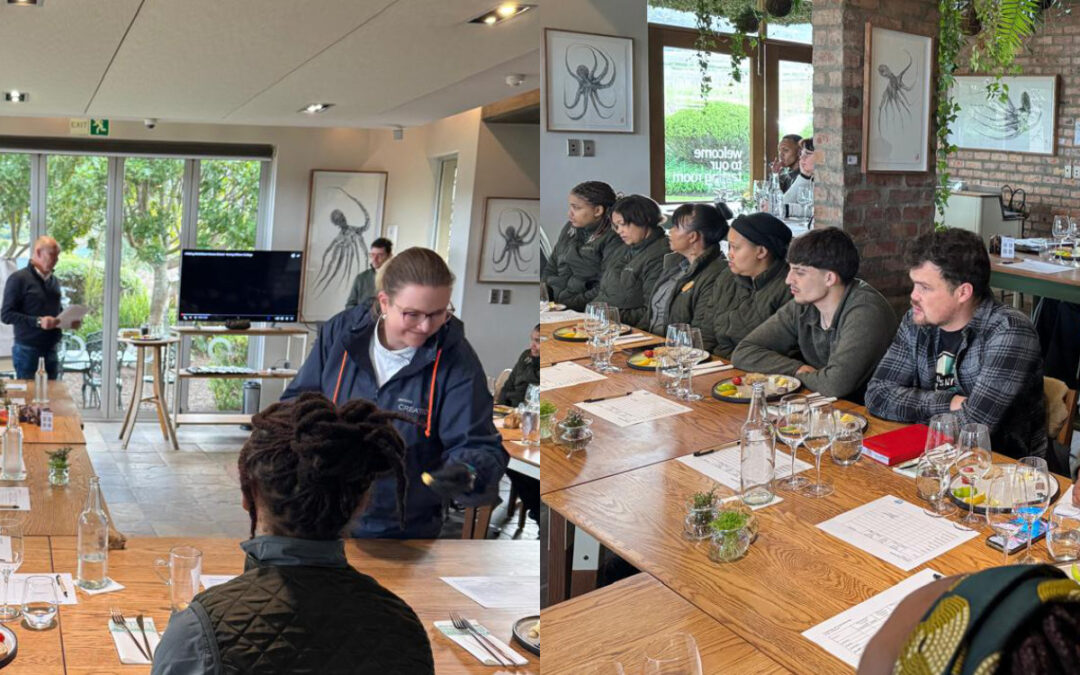
Our recent masterclass at Creation, led by the inspiring Netherlands-based gastronomy trainer Hugo Linskens, invited us to experience something deeply familiar – taste – through a new lens. What began as a circle of everyday ingredients on a plate became a sensory journey through flavour, language and perception, revealing the subtle difference between tasting something and learning to speak about it.
Setting the Scene: The Circle of Taste
A plate arranged like a clock: lemon, apple, tomato, bread crumb, bread crust, grated cheese, matured cheese, milk chocolate, dark chocolate, and macadamia nuts. Each ‘hour’ represented a taste waiting to be explored – from lemon’s zing to the creamy richness of macadamia.
Guided by Hugo’s sensory-first approach, we moved clockwise, awakening the palate, pausing between bites, and asking ourselves not ‘do I like this?’ but ‘what is this doing to my mouth?’
A Surprising Challenge
Before diving into the tasting, Hugo posed a challenge to three team members: ‘Describe something incredibly familiar – white bread, milk chocolate, or a Margherita pizza – to a group of “buyers” who have never tasted it before. The twist? Your goal is to convince them to purchase 30 pallets.’
As passionate food lovers, they rose to the challenge. But, as we all witnessed, describing taste – clearly, persuasively and without falling into generalities – is far more difficult than it seems.
Why? Because taste is emotional.
It’s deeply personal, shaped by memory, mood and context. And for professionals in food and wine, that emotional experience needs to be translated into a shared, objective language – one that allows chefs, sommeliers and service teams to communicate clearly and consistently.
The Multi-Dimensional Language of Flavour
This is where Hugo introduced us to the work of Dutch flavour theorist Peter Klosse, who developed a model to help professionals describe flavour not based on opinion, but on how food behaves in the mouth.
We explored three dimensions, using a simple 1–10 scale:
- Mouthfeel – from contracting (sharp, dry) to coating (creamy, lingering)
- Volume – the intensity or ‘loudness’ of the flavour
- Richness – from fresh and light to deep and full
What was truly remarkable: within just 90 minutes, participants were able to speak a shared, objective and professional language about flavour. Despite having different palates and perspectives, they could describe what they were tasting in consistent and aligned terms – a rare and empowering shift for any team in wine and food.
It was not about right or wrong; it was about developing a common vocabulary – one rooted in physical experience rather than emotion alone.
The Sensory Circle: Tasting with Intent
As we tasted, each ingredient taught us something:
- Lemon’s acidity creates a contracting sensation
- Aged cheese and dark chocolate delivers richness and intensity
- Bread crumb coats, while bread crust adds texture and toasty notes
We discovered that flavour has shape. That flavour evolves. And that when we observe these patterns together, we begin to speak a common language.
The Science Behind Flavour
From bread crust to mature cheese, we learned about the Maillard reaction – the transformation of sugars and proteins into new, complex flavour compounds through heat. This scientific ‘magic’ is what gives cooked and aged foods their rich, roasted character.
The Influence of Mood, Season and the Cosmos
True to Creation’s biodynamic spirit, Hugo also encouraged us to consider the more poetic side of taste – how mood, weather, even lunar cycles can influence our perceptions.
Season, too, plays its part. In summer, we naturally gravitate toward fresh, crisp, lower-volume flavours – such as green apples, lemon, or young cheese. In winter, our preferences often shift toward riper, deeper, and more coating flavours – aged cheese, dark chocolate, and rich sauces. Understanding these seasonal tendencies can help guide both menu design and wine pairing choices in a more intuitive way.
Building a Menu: Letting Volume Rise
One practical insight from the session was how to build a menu that respects the natural crescendo of flavour:
- Begin with gentle, fresh notes
- Allow richness and mouthfeel to increase gradually
- Conclude with bold, sweet and coating sensations – dessert as the final crescendo
This progression mirrors both seasonal shifts and human appetite – from light to full, soft to loud – creating a sense of balance and story across the meal.
Why Language Matters
Describing flavour is difficult because our brain’s taste and language centres are not directly connected. That’s why food professionals – chefs, writers, sommeliers – must learn to speak through metaphor, texture, memory, and sensation.
With the right tools, we move from vague and emotional to clear and professional – without losing the poetry.
Key Takeaways – For Team and Guest Alike
For the Team:
- Flavour is multi-dimensional – explore it together.
- Use shared language to improve communication, pairings and guest connection.
- Let structure and creativity work side by side.
For Guests and Readers:
- Be present. Reflect. Let the food speak to all your senses.
- There are no wrong impressions, only moments of awareness waiting to be explored.
- Trust your palate and enjoy the beauty of discovery.
Final Thoughts
To taste is to feel. To describe taste is to connect. And to share that experience – with clarity, with care, and with curiosity – is what makes our world of food and wine so deeply human.
In just one and a half hours, we witnessed how quickly a team can align – not by opinion, but by learning to observe objectively, speak precisely, and listen openly.
Whether you’re behind the stove, at the table, or simply someone who loves to savour, let every bite be a step toward understanding – of self, of others, and of the magic where science meets art.
Taste well. Speak clearly. Let the volume rise.