


“Balance is not a passive resting place – it takes work, balancing the giving and the taking, the raking out and the putting in.” ― Robin Wall Kimmerer, from Braiding Sweetgrass: Indigenous Wisdom, Scientific Knowledge, and the Teachings of Plants
As someone who likes wine, I know an awful lot about dirt. I can look at the ground and confidently point out the differences between koffieklip and shale, quartz and sandstone. I can say annoying things like, ‘Oh, you know, weathered granite – it’s just a fancy word for sand!’ and know when that line will land as a hilarious punchline or get me banned from all future dinner parties. Forever. But it’s not my fault. Wine people are obsessed with soil.
At its heart, terroir is the connection between place through taste. But to think the story of terroir begins and ends with soil is not only limiting, but also flattening. Terroir is about the earth and the sky, yes, but it’s also about the meaning we make of the space between. It’s the translation of the natural landscape through human endeavours, so that taste isn’t just a list of flavours, but a culture, an expression of ancestry.
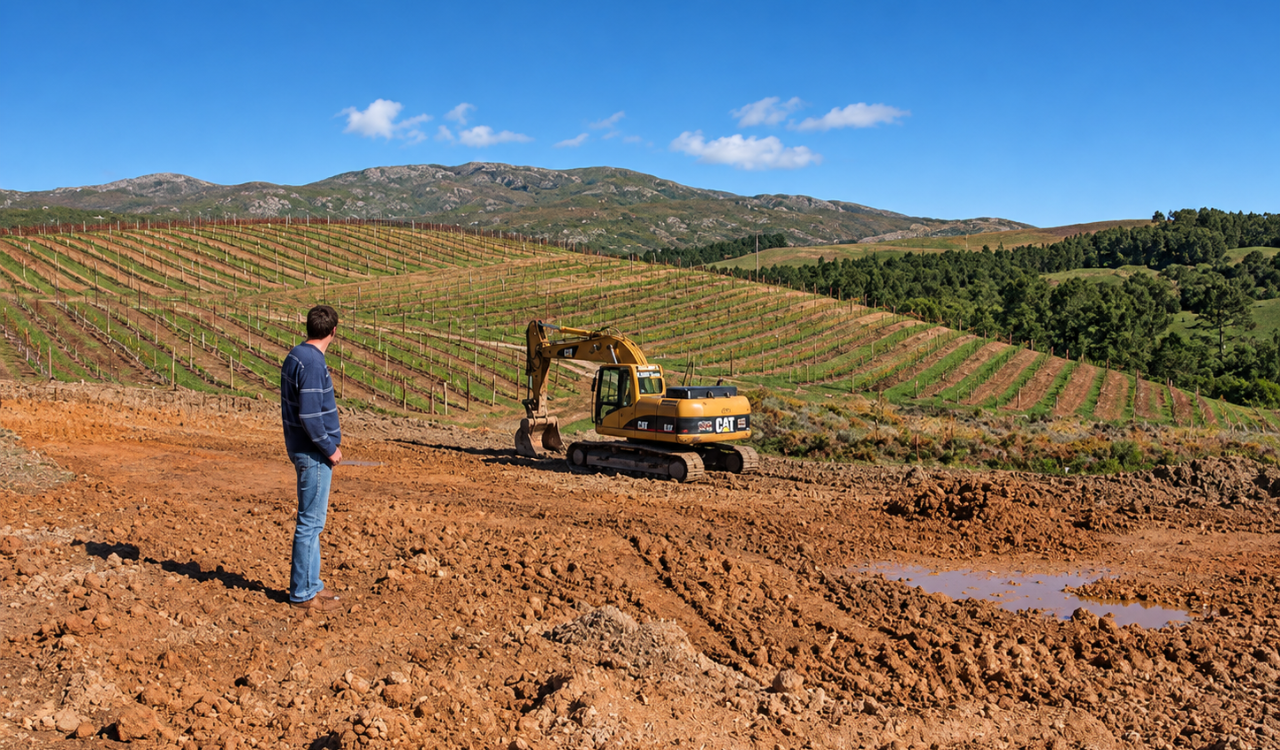
Back in 2002, JC and Carolyn Martin had no intention of buying a wine farm. At the time, they worked at JC’s family winery in Switzerland. But when Peter Finlayson (Carolyn’s uncle of both Hamilton Russell Vineyards and Bouchard Finlayson fame) pulled JC aside during their annual Hermanus visit to say he’d found the perfect piece of land… well, I’d say the rest is history, but I’d be missing some crucial steps in between.
In the beginning, there was nothing. Well, nothing except for a shepherd and his flock of sheep. Accessible only by 11km of dirt road that rose in clouds of dust in the summer and froze over in winter, it was a sheep farm with no buildings, no running water, no electricity and certainly no vineyards. Together, JC and Carolyn became the first generation to plant vines in the Hemel-en-Aarde Ridge, founding Creation and effectively starting a new terroir in South Africa.
The Ridge is the smallest of the three Hemel-en-Aarde wards. The towering Babylonstoring peak marks its border, a magnet for clouds to wrap around and crash against. Mirroring the Atlantic’s waves just beyond the opposing Klein River mountain, the slopes here rise and fall, concertinaed in their aspects. They look, for lack of a better word, ‘ridgy’. Sharing the same soils as the Hemel-en-Aarde Valley of Bokkeveld shale, granite, quartz and clay, the Ridge expresses its difference through altitude and a handful of additional kilometres from the ocean: the temperatures are cooler, the difference between days and nights starker, the winters frostier, the harvesting dates later.
The result is wines at once elegantly perfumed, yet deeply structured by the clay soils. They express darker fruits with a serious tannin profile, where the cool climate gives them a locked-in freshness, while the ocean and altitude imbue a mineral seam.
But if land and climate were all that determined a wine, there’d be no need for winemakers. ‘All the decisions you make farming are driven by the soil you have to work with,’ says JC. The varieties you plant, the clones you choose, the rootstocks you graft them onto, the row direction you orient them in, how densely you plant, the trellising system you select, the farming practices you subscribe to, the timing of when you choose to enact them… it’s all human.
Minimal intervention is not about doing nothing; it’s about reading the land to the extent that even the smallest action is in fulfilment of that expression.
Alongside already proven Chardonnay and Pinot Noir, Creation began with a host of Bordeaux plantings. But when JC realised ‘the world wasn’t holding its breath for a Creation Merlot’, they pulled their Bordeaux vineyards in favour of Rhône varieties – and more Chardonnay and Pinot Noir, of course. Soon, upon Glenn’s request, Creation’s second-generation winemaker, they will plant a block of Trousseau (also known as Bastardo) just to ‘spice things up a little bit’.
Creation also introduced Guyot, a trellising system JC was initially told would never work in the area, but has since proven so successful that other producers in the valley have adopted it. Unless strictly necessary, no herbicides are used, and almost everything is done by hand. Soils aren’t tilled by tractors, but gently lifted at an angle with a special plough to minimise carbon loss. Cover crops – the height of viticultural fashion – are avoided, and with it, the need for fertiliser, additional water and unnecessary competition for growth. Instead, Glenn’s passion is to restore the natural fynbos between rows, so that tongblaar, imfino and honeybush infuse the vineyards with their fragrance.

While wine might be made in the vineyard, culture is made in the tasting room. When Carolyn wanted to build a tasting room, the idea was initially laughed at. ‘No one could even pronounce Hemel-en-Aarde,’ says Carolyn. ‘Everyone said to me that no one would ever come. But when you make fine wine, people need to be able to experience it firsthand.’
What began as a small tasting room with four employees and Carolyn dragging her living room couches from home every weekend soon turned into a 90-person operation. Hospitality has become central to the Creation experience, serving not only wine, but food made with indigenous ingredients, their ancestral meanings explained by local staff whose heritage in the area goes back generations. ‘We take care of people,’ says Jenean Booysen simply, having worked in the tasting room since 2009. Today, Creation is ranked the 7th best vineyard in the world and Hemel-en-Aarde is part of the first African UNESCO City of Gastronomy.
Creation has not only built the Ridge’s first generation of terroir, but also inspired the first generation of wine drinkers in the greater local Hermanus, Stanford and Caledon area. ‘I haven’t grown up with wine at all,’ says Jenean. ‘You have to give me a beer and brandy – that’s typical me. Creation got us all into wine.’
Four of Creation’s tasting room staff are graduates of the Pebbles Project Youth Development Centre , a community initiative co-founded and supported by Creation. One of them is Maryka van Wyk, who has also gained her WSET wine qualification. ‘Working here has truly changed the person I was before. Pebbles gave me potential, but Creation allowed me to live out that potential,’ she says.
‘At Creation, you get opportunities,’ adds Kirsten Myburgh, who’s worked as a cellar hand for 13 years, cleaning tanks and barrels, and, since 2019, has produced his own barrel of Chardonnay every year.
‘We are creating a sense of place,’ says Carolyn, ‘and people need to understand how important they are as part of it. They know the lay of the land. They know everything because they were born here and they’ve grown up here.’
Terroir is so much more than dirt – it’s also the vast expanse of the people who live in the space between heaven and earth. As warehouse manager Mandy Gardiner puts it: ‘I belong here. I just have a connection with everything that goes on, starting from nature, the people, the guests. Everything.
Words by Raphaela van Embden | Follow Raph on Instagram